This Isn’t a Stucco Problem. It’s a 1993-2006 Problem.
Stucco has been cladding homes for a hundred years without falling apart. So why do so many houses in Chester, Montgomery, Bucks, and Delaware counties, plus parts of Philadelphia, have rot behind the walls right now?
The answer isn’t the material. It’s the decade.
Between 1993 and 2006, this region went through one of the biggest new-construction booms in its history. Whole developments went up in a fraction of the time it should have taken. Crews were paid by the house, not by the hour, and stucco installation got compressed into a step that should never be rushed. Inspection oversight at the time didn’t catch what was happening behind the finish coat, because from the street, every one of these houses looked fine.
They still look fine today. That’s the problem. Stucco hides what’s underneath it better than almost any other siding material, which means a house can be losing structural integrity for a decade before anyone notices a stain, a soft spot, or a warped window sill.
What Actually Went Wrong Behind the Wall
No Weather-Resistant Barrier
Stucco is not waterproof. It was never supposed to be the only line of defense. Behind every properly built stucco wall, there’s supposed to be a weather-resistant barrier, a layer that gives water somewhere to go if it gets past the stucco itself, which it always eventually does through hairline cracks and joints.
On a huge number of homes from this era, that barrier is missing entirely, or it was installed so thin and so poorly lapped that it does almost nothing. Water gets behind the stucco, hits bare sheathing, and just sits there.
Missing Kickout Flashing
Anywhere a roofline meets a wall, water running off the roof has to be redirected away from the wall. That’s what kickout flashing does. It’s a small piece of metal, and on paper it’s a minor detail.
In the field, it’s one of the most common things we find missing on homes from this era. Without it, roof runoff dumps straight down the wall cavity at that intersection, year after year, concentrated in one spot. Those spots are almost always where the worst rot shows up.
No Control Joints
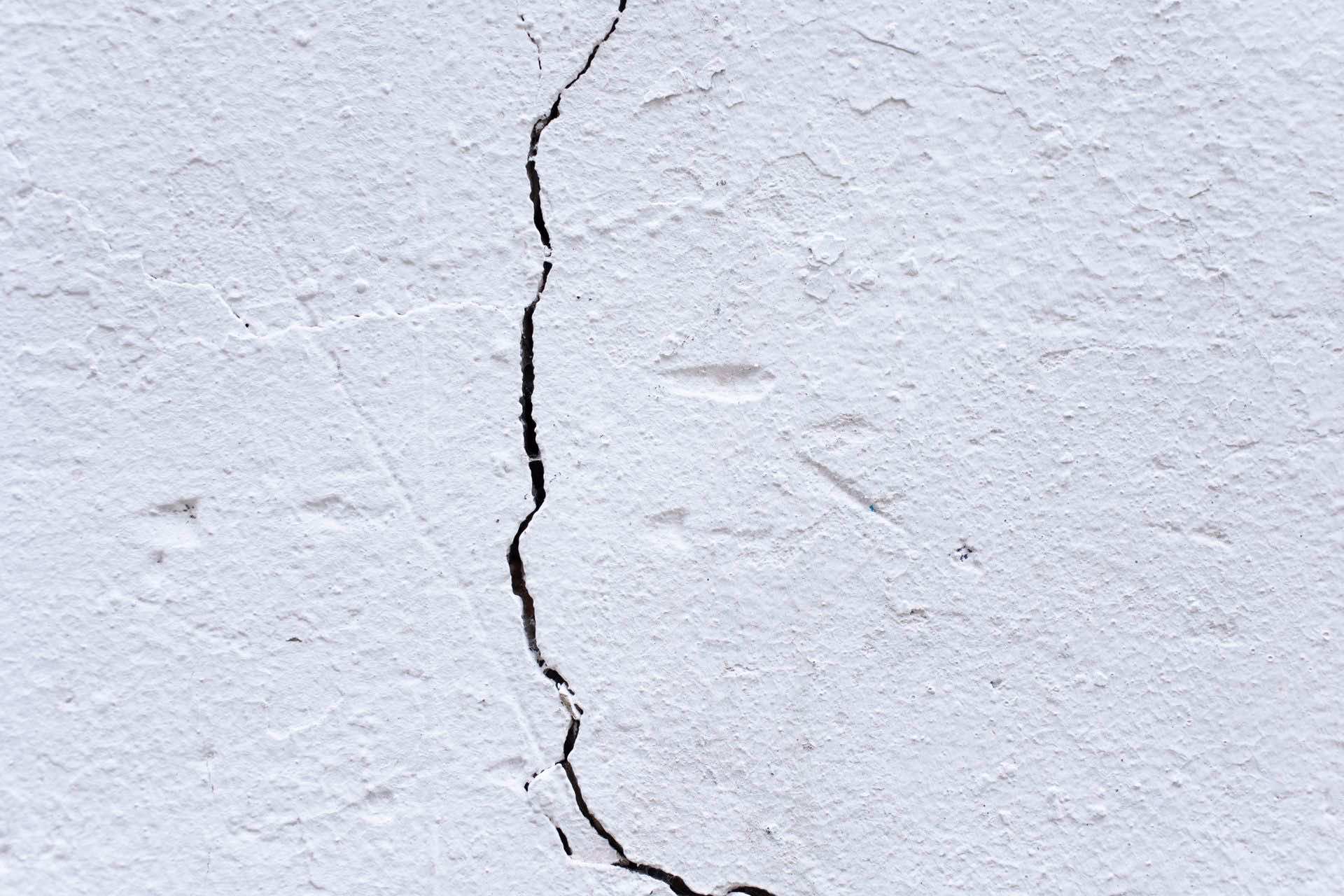
Stucco expands and contracts. A wall without control joints has nowhere for that movement to go, so it cracks instead, in whatever pattern the stress finds. Once a wall is cracked, it’s no longer a question of if water gets in, it’s a question of how much and how often.
Caulk That Was Never Going to Hold
Every window, every door, every pipe or vent that punches through a stucco wall needs a sealant joint that’s installed correctly and replaced on a schedule. Sealant is not a permanent fix. It’s a wear item, like a tire.
On builder-grade construction from this period, sealant joints were often installed once, cheaply, and never revisited. Twenty-plus years later, most of that original caulk has failed completely, and a lot of homeowners don’t know it’s a maintenance item at all.
Stucco Applied Directly Over Sheathing
Put those failures together and you get the worst version: stucco troweled straight onto the sheathing with no drainage plane behind it. When that assembly cracks, or the sealant fails, or a kickout is missing, there is nothing between the water and the wood framing of the house. No gap, no barrier, no path back out.
Why Pennsylvania Winters Make Everything Worse
A crack that would sit quietly on a house in a mild climate becomes an entry point twice a year here. Water gets into a crack in the fall, freezes in the winter, and expands. Ice is a wedge. It widens whatever crack it’s sitting in.
Come spring thaw, that wider crack lets in more water than it did the year before. This is why moisture problems in this region tend to accelerate rather than stay flat. A wall that had a minor issue five years ago can have a serious one now, and the freeze-thaw cycle is a big part of why. We see the sharpest jump in reported symptoms, stains, soft trim, bulging paint, in late winter and early spring, right after that cycle has had months to work.
Properly Installed Stucco Doesn’t Do This
This matters because it changes what the fix actually is. A house with a correct weather barrier, correct flashing, correct joints, and a normal sealant maintenance schedule handles decades of Pennsylvania weather without rotting from the inside. Stucco isn’t the defect. The installation practices common to this specific building boom are the defect.
That’s also why remediation isn’t just “redo the stucco.” It’s fixing the assembly behind it, so the same failures don’t repeat in another twenty years.
What We See in the Field
A typical example: a 1998 colonial in a Chester County development, stucco applied direct to sheathing, no visible weather barrier at the few spots we could probe without demolition. The homeowners had noticed a soft patch of trim near a second-floor window for about a year and assumed it was a paint problem. Moisture testing showed elevated readings at framing level on that entire elevation, concentrated around the window and worse near the roofline, exactly where the kickout flashing was missing. The rest of the house tested closer to normal. That’s a common pattern: the damage usually isn’t uniform, it’s concentrated at the specific details that were built wrong.
Where to Go From Here
If your inspection report already flagged elevated moisture, the next question isn’t what it will cost. It’s what the testing actually found, elevation by elevation. We break that down on our moisture testing page. If you’re trying to understand what a report means for a home you already own, or one you’re trying to buy, we can help with either. Send us your inspection report and we’ll tell you what it actually means, usually within one business day.